Every year, as the calendar flips to September, a familiar bittersweet feeling settles in. The pools start closing, the barbecues wind down, and everyone talks about Labor Day weekend as summer’s last hurrah.
However, summer doesn’t officially end until the autumnal equinox in late September, weeks after Labor Day. So, why does this holiday get treated as the definitive end of the season?
The answer is a mix of history, tradition, and cultural habits. Labor Day weekend is when Americans squeeze in their final summer celebrations, break out their patriotic shirts one last time, and mentally shift toward fall. Here’s the story behind why this particular Monday carries so much weight.
Labor Day Wasn’t Created To End Summer
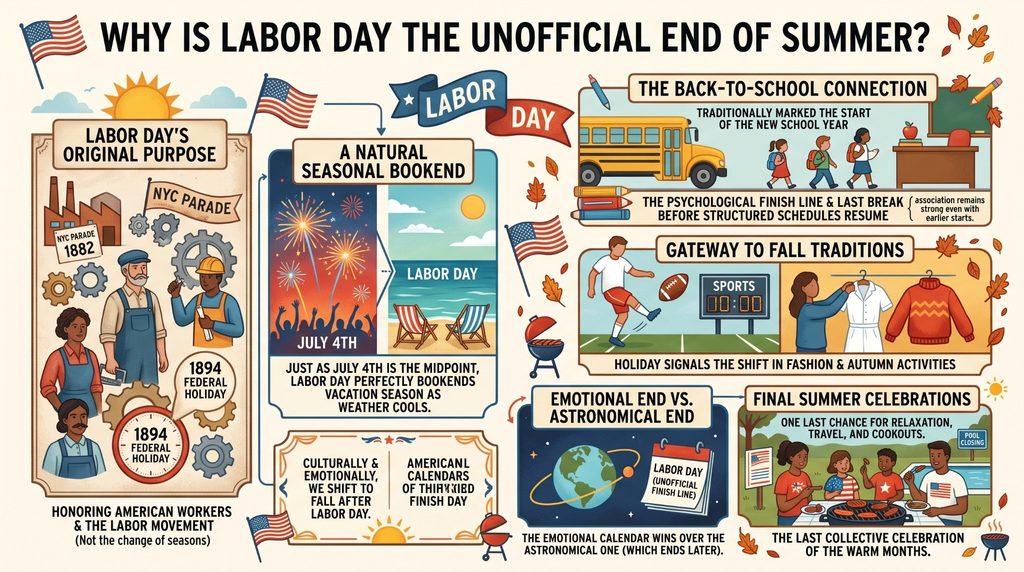
First, it helps to understand what Labor Day actually is. The holiday has nothing to do with the change of seasons in its origins. It was created to honor the American labor movement and the contributions workers made to the country’s strength and prosperity.
The holiday emerged in the late 19th century during the Industrial Revolution, when trade unions and labor movements were fighting for better working conditions, shorter hours, and fair treatment. The first Labor Day parade was organized in New York City in 1882.
After growing state-level adoption, Labor Day became a federal holiday in 1894, observed on the first Monday of September. Its purpose was celebration and recognition of workers, not marking the calendar.
The Timing Made It a Natural Bookend
So, how did a workers’ holiday become the unofficial close of summer? A lot of it comes down to timing. Labor Day falls in early September, right when the rhythms of American life naturally shift.
This is the moment when summer vacations wrap up, when the weather begins its slow turn toward fall, and when the long, lazy days start giving way to more structured schedules. Just as the Fourth of July functions as the exuberant midpoint of summer, Labor Day sits at the other end as the season’s natural bookend.
The Back-to-School Connection
Perhaps the biggest reason Labor Day became synonymous with summer’s end is the school calendar. For generations, American schools traditionally resumed classes right after the Labor Day weekend. The three-day weekend served as the final break before students returned to the classroom.
That connection cemented Labor Day as the psychological end of summer for millions of families. The holiday meant the last chance for a family trip, the final beach day, and the closing of the carefree summer chapter before the structured school year began.
While many districts now start school in early or mid-August, the cultural association between Labor Day and back-to-school time has proven remarkably durable.
A Marker for Fall Traditions
The weekend has long marked the start of numerous autumn traditions, reinforcing its role as a seasonal turning point. Fall high school and college sports seasons traditionally kick off around Labor Day. Many fall fashion norms were tied to it as well, including the famous old rule that you shouldn’t wear white after Labor Day.
These overlapping traditions all pointed in the same direction, framing the holiday as the gateway between the warm, relaxed summer months and the busier, cooler fall season.
The Cultural Weight of a Long Weekend
There’s also something about the holiday’s structure that reinforces the end-of-summer feeling. Labor Day is one of the last guaranteed long weekends before the stretch of fall and early winter, when holidays become scarce until Thanksgiving.
Families use this final three-day weekend to take one last trip, host one more cookout, or simply enjoy the last unofficial permission slip to relax before the pace of life picks up again. Because it serves as the last major collective celebration of the warm season, it naturally has absorbed the role of summer’s send-off party.
Summer’s Emotional End vs. Its Astronomical End
It’s worth noting the distinction between how we feel about summer and when it technically ends. Astronomically, summer continues until the autumnal equinox, which usually falls around September 22nd or 23rd. By that measure, there are nearly three full weeks of official summer left after Labor Day.
But seasons are as much about culture and emotion as they are about the position of the Earth relative to the sun. For most people, summer ends when it feels like it ends, and Labor Day, with its back-to-school timing, cooling weather, and final-celebration energy, feels like the finish line. The emotional calendar wins out over the astronomical one.
A Tradition That Endures
Even as school start dates have crept earlier and many of the old traditions have faded, Labor Day’s status as the unofficial end of summer remains firmly intact. It’s a testament to how deeply cultural rhythms embed themselves in our collective consciousness.
While Labor Day was born as a tribute to American workers, it has taken on this second identity as summer’s farewell. This year, as you enjoy that final long weekend, you can appreciate both meanings: honoring the workers who built the country and savoring the last golden days of the season before fall officially arrives.