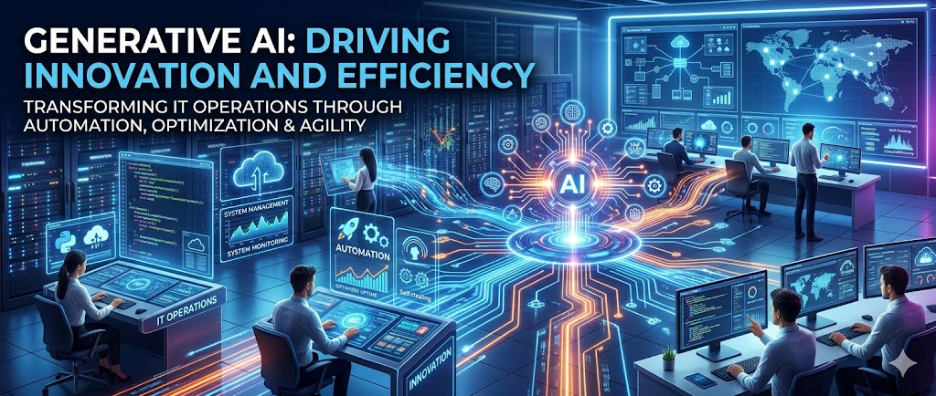
Organizations are under increasing pressure to modernize their IT functions while managing rising complexity, cost constraints and evolving business demands. Traditional automation and analytics have improved efficiency over time, but they often lack the adaptability needed to respond to rapid technological change. Generative artificial intelligence is emerging as a transformative force, enabling IT teams to move beyond static processes and toward dynamic, intelligent operations.
By leveraging advanced machine learning models, generative AI allows IT organizations to create new insights, automate complex workflows and enhance decision-making. It supports everything from software development to infrastructure management, helping organizations become more agile, resilient and data-driven. As adoption accelerates, generative AI is redefining how IT delivers value across the enterprise.
Overview of generative AI in IT
Generative artificial intelligence refers to systems that can produce new content, such as code, documentation, simulations and recommendations, based on patterns learned from large data sets. In IT environments, this capability enhances both operational efficiency and innovation by enabling intelligent automation and advanced analytics.
Unlike traditional tools that rely on predefined rules, generative AI can adapt to changing conditions and generate multiple possible outcomes. This allows IT teams to address challenges, optimize performance and support strategic initiatives proactively.
Organizations exploring Generative AI in IT are leveraging these capabilities to modernize their technology landscape. From improving service management to accelerating software development, generative AI is becoming a critical component of IT transformation.
Generative AI integrates seamlessly with existing IT systems, including cloud platforms, enterprise applications and cybersecurity frameworks. It enhances these systems by providing real-time insights, automating repetitive tasks and improving overall visibility into IT operations.
Benefits of generative AI in IT
Generative AI offers significant advantages that help IT organizations improve performance, reduce costs and drive innovation.
1. Enhanced productivity and efficiency
Generative AI automates routine IT tasks such as code generation, system monitoring and incident resolution. This reduces manual effort and allows IT professionals to focus on higher-value activities. By streamlining workflows, organizations can achieve faster turnaround times and improved operational efficiency.
2. Improved software development lifecycle
Generative AI accelerates software development by assisting with code generation, testing and debugging. Developers can use AI-generated suggestions to write code more efficiently and reduce errors. This leads to shorter release cycles and higher-quality applications.
3. Better IT service management
Generative AI enhances IT service management by automating ticket resolution and providing intelligent recommendations. It can analyze historical data to predict issues and suggest proactive solutions. This improves service quality and reduces downtime.
4. Advanced cybersecurity capabilities
Cybersecurity is a critical concern for IT organizations. Generative AI helps identify potential threats by analyzing patterns and generating risk scenarios. It enables faster detection and response to security incidents, strengthening overall system protection.
5. Data-driven decision-making
Generative AI provides actionable insights by analyzing large volumes of data from multiple sources. It supports scenario planning and helps IT leaders make informed decisions. This leads to more effective strategies and improved business outcomes.
Use cases of generative AI in IT
Generative AI is being applied across various IT functions, delivering measurable value in real-world scenarios.
1. Code generation and development support
Developers use generative AI to generate code snippets, automate testing and improve debugging processes. This reduces development time and enhances productivity. It also helps standardize coding practices and improve software quality.
2. IT operations and incident management
Generative AI analyzes system data to identify anomalies and predict potential issues. It can generate recommendations for resolving incidents and automate response processes. This improves system reliability and minimizes downtime.
3. Knowledge management and documentation
Generative AI creates and maintains IT documentation, including user guides, system manuals and knowledge bases. It ensures that information is up to date and easily accessible. This enhances collaboration and supports efficient knowledge sharing across teams.
4. Cloud and infrastructure optimization
Generative AI optimizes cloud resource allocation by analyzing usage patterns and generating recommendations. It helps organizations reduce costs while maintaining performance. This is particularly valuable in complex, multi-cloud environments.
5. IT strategy and planning
Generative AI supports IT leaders in developing strategic plans by simulating different scenarios and evaluating potential outcomes. It provides insights that guide decision-making and resource allocation.
Organizations often complement these capabilities with digital transformation strategy consulting to ensure alignment with broader business goals.
Why choose The Hackett Group® for implementing generative AI in IT
Implementing generative AI in IT requires a combination of technical expertise, strategic insight and proven methodologies. The Hackett Group® is recognized for its research-driven approach and deep functional expertise in IT transformation.
The firm helps organizations adopt generative AI that aligns with their business objectives and delivers measurable results. Its focus on benchmarking and best practices ensures that organizations achieve world-class performance.
1. Proven benchmarks and best practices
The Hackett Group® leverages extensive benchmarking data to identify performance gaps and opportunities for improvement. This enables organizations to adopt strategies that are aligned with industry best practices. By comparing performance against peers, companies can prioritize initiatives that deliver the greatest impact.
2. Comprehensive transformation approach
From strategy development to execution, The Hackett Group® provides end-to-end support for IT transformation. This includes process optimization, technology integration and change management. This holistic approach ensures the successful adoption of generative AI across IT functions.
3. Advanced platforms and tools
The Hackett Group® offers advanced platforms such as Hackett AI XPLR™ and AskHackett™ to accelerate generative AI adoption. These tools provide insights, automation capabilities and decision support that enhance IT performance. They enable organizations to scale AI initiatives effectively and achieve faster results.
4. Focus on measurable outcomes
A key strength of The Hackett Group® is its emphasis on delivering tangible business value. The firm focuses on metrics such as cost efficiency, service quality and operational performance. This ensures that generative AI initiatives drive real improvements rather than simply introducing new technology.
Conclusion
Generative artificial intelligence is transforming IT by enabling smarter, faster and more efficient operations. Its ability to generate insights, automate processes and support decision-making makes it a powerful tool for modern IT organizations.
From software development to cybersecurity and strategic planning, generative AI is reshaping how IT delivers value. Organizations that embrace this technology can improve performance, reduce costs, and gain a competitive advantage.
As the technology continues to evolve, successful adoption will depend on a clear strategy, the right expertise and a focus on measurable outcomes. By leveraging proven methodologies and advanced tools, organizations can harness the full potential of generative AI and drive meaningful transformation in their IT functions.