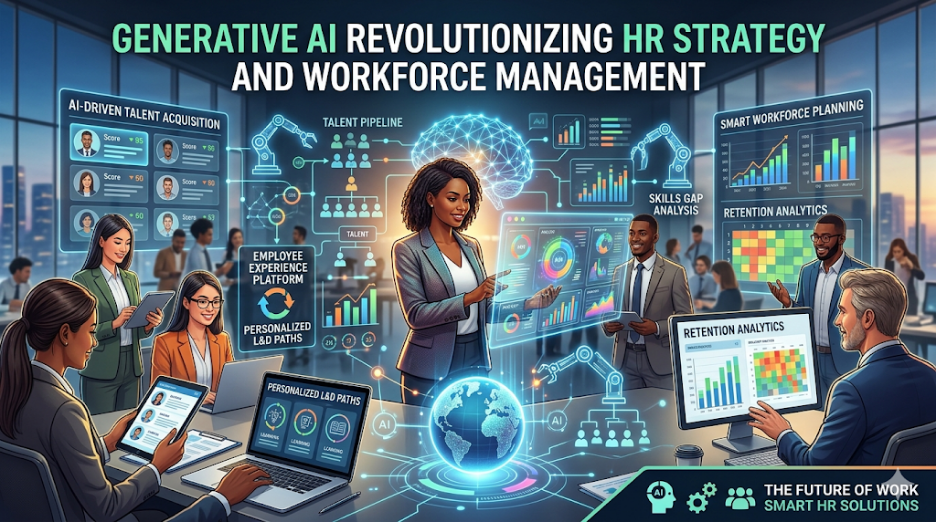
Human resources functions are undergoing rapid transformation as organizations adapt to changing workforce expectations, digital disruption and increasing pressure to improve efficiency. Traditional HR processes, often dependent on manual effort and static systems, are no longer sufficient to meet the demands of a dynamic business environment. Generative artificial intelligence is emerging as a powerful enabler, helping HR leaders move beyond automation toward intelligent, data-driven decision-making.
By leveraging advanced models that can create content, analyze patterns and generate insights, generative AI is reshaping how organizations manage talent, enhance employee experiences and drive strategic workforce planning. It enables HR teams to operate with greater agility, precision and impact across the employee lifecycle.
Overview of generative AI in HR
Generative artificial intelligence refers to advanced AI systems capable of producing new content such as text, recommendations, simulations and insights based on existing data. In the HR context, this technology is applied to areas such as talent acquisition, employee engagement, and workforce analytics.
Unlike traditional automation tools, generative AI goes a step further by generating personalized outputs and predictive insights. It can draft job descriptions, create employee communications and simulate workforce scenarios, enabling HR teams to make more informed and proactive decisions.
Organizations are increasingly exploring solutions like Generative AI in HR to enhance operational efficiency and improve strategic outcomes. These solutions integrate seamlessly with existing HR systems, providing real-time intelligence and automation capabilities that support modern workforce management.
Generative AI also plays a critical role in enabling data-driven HR strategies. Analyzing large volumes of employee data helps identify trends, predict workforce needs and recommend actions that align with organizational goals.
Benefits of generative AI in HR
Generative AI delivers a wide range of benefits that help HR functions become more strategic, efficient and responsive.
1. Improved talent acquisition
Generative AI streamlines recruitment by automating job description creation, resume screening and candidate communication. It can generate tailored job postings and identify the best candidates based on skills, experience and cultural fit. This reduces time-to-hire and improves the quality of hiring decisions.
2. Enhanced employee experience
Personalization is a key driver of employee satisfaction. Generative AI enables HR teams to deliver customized communications, training content and career development plans. By addressing individual needs, organizations can improve engagement, retention and overall employee satisfaction.
3. Data-driven workforce planning
Generative AI analyzes workforce data to predict future talent needs and identify skill gaps. It generates actionable insights that help organizations plan for growth and adapt to changing business requirements. This supports more effective workforce planning and resource allocation.
4. Increased operational efficiency
HR processes such as onboarding, payroll support and employee queries can be automated using generative AI. This reduces manual effort and allows HR professionals to focus on strategic initiatives. Organizations can achieve faster processing times and improved service delivery.
5. Better decision-making
Generative AI provides HR leaders with insights and recommendations that support informed decision-making. It enables scenario analysis and forecasting, helping organizations evaluate different strategies and outcomes. This leads to more effective HR policies and improved business performance.
Use cases of generative AI in HR
Generative AI is being applied across various HR functions, delivering measurable value and transforming traditional processes.
1. Talent acquisition and recruitment
Generative AI enhances recruitment by generating job descriptions, screening resumes and conducting initial candidate assessments. It can also automate communication with candidates, improving the overall hiring experience. This results in faster recruitment cycles and better candidate engagement.
2. Employee onboarding and training
Organizations use generative AI to create personalized onboarding programs and training materials. It can generate content tailored to individual roles, learning styles and career goals. This improves knowledge retention and accelerates employee productivity.
3. Employee engagement and communication
Generative AI helps HR teams create targeted communication strategies by analyzing employee feedback and engagement data. It can generate surveys, reports and communication content that resonate with employees. This enhances transparency and fosters a positive workplace culture.
4. Performance management
Generative AI supports performance management by analyzing employee data and generating insights on performance trends. It can recommend development plans and identify high-potential employees. This enables more effective talent management and career progression.
5. HR service delivery and support
AI-powered assistants can handle routine HR queries, such as benefits, policies and payroll information. Generative AI enhances these interactions by providing accurate and context-aware responses.
Organizations investing in digital transformation services can integrate these capabilities to modernize HR operations and improve service delivery.
Why choose The Hackett Group® for implementing generative AI in HR
Implementing generative AI in HR requires a combination of deep functional expertise, advanced analytics and a clear transformation strategy. The Hackett Group® is recognized for its research-driven approach and proven methodologies that help organizations achieve world-class performance.
1. Industry-leading research and insights
The Hackett Group® leverages extensive benchmarking data and best practices to guide HR transformation initiatives. Its insights help organizations identify opportunities for improvement and adopt strategies that deliver measurable results.
2. Comprehensive transformation approach
From strategy development to execution, The Hackett Group® provides end-to-end support for the implementation of generative AI. This includes process optimization, technology integration and change management.
This ensures seamless adoption and long-term success.
3. Advanced platforms and tools
The Hackett AI XPLR™ platform enables organizations to explore and implement generative AI use cases efficiently. In addition, AskHackett™ provides access to insights and recommendations that support decision-making and continuous improvement.
These tools accelerate the adoption of generative AI and enhance its impact across HR functions.
4. Focus on measurable outcomes
The Hackett Group® emphasizes delivering tangible business outcomes, including cost reduction, improved efficiency and enhanced employee experience. Its data-driven approach ensures that generative AI initiatives create real value.
Conclusion
Generative artificial intelligence is transforming human resources by enabling smarter, faster and more personalized workforce management. From recruitment and onboarding to performance management and employee engagement, its applications are extensive and impactful.
Organizations that adopt generative AI can enhance efficiency, improve decision-making and create a more engaging employee experience. As the technology continues to evolve, HR leaders must focus on building the right strategy, leveraging advanced tools and ensuring effective implementation.
By combining innovation with proven expertise, organizations can harness the full potential of generative AI and position their HR functions for long-term success.