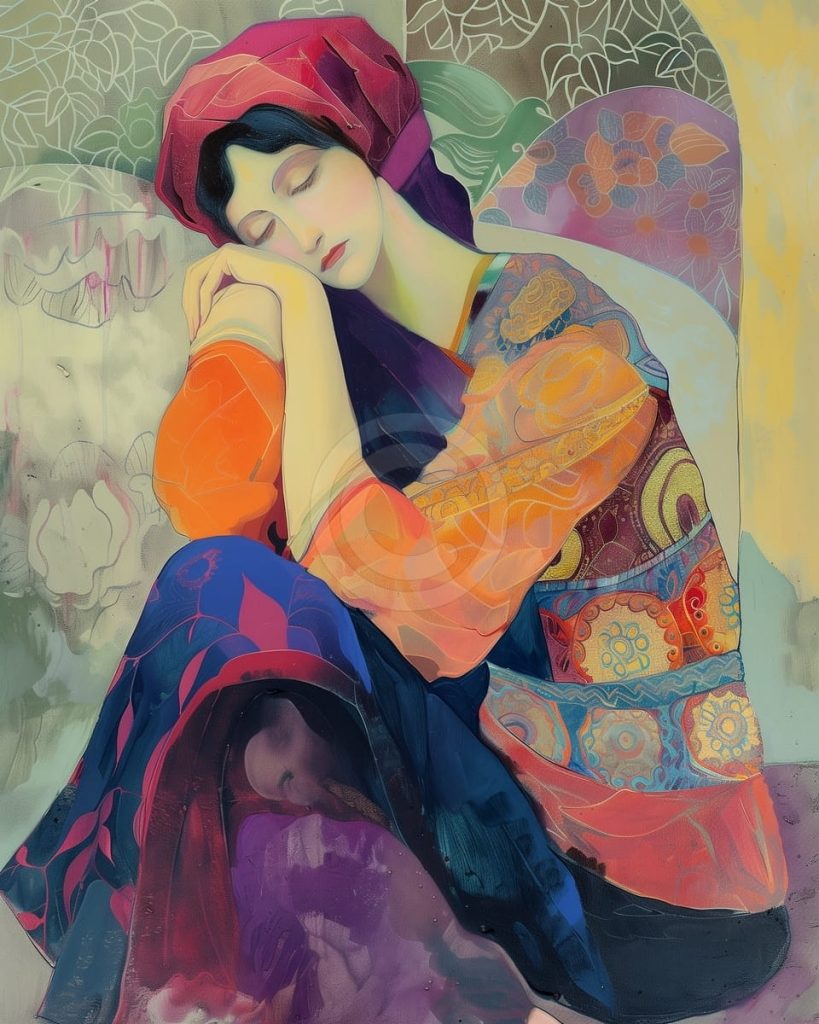
Every night, without exception, you enter another world.
The rules of waking life dissolve. Time folds back on itself. People you have not seen in years appear without explanation. Landscapes shift and merge. Objects carry meanings you cannot articulate but feel with absolute certainty. And then you wake — and within minutes, most of it is gone.
Dreams are the most vivid, most personal, and most mysterious experiences available to human consciousness. They have fascinated healers, philosophers, priests, and scientists for as long as records exist. And they have fascinated artists — painters in particular — who have spent centuries attempting to do what seemed impossible: to hold the dream still long enough to put it on canvas.
This is the story of dream paintings — what they are, what they mean, and what they reveal about the inner life we all carry into sleep.
Why Dreams and Painting Have Always Found Each Other
There is a reason that painters, above almost all other artists, have been drawn to the dream world as a subject.
Writing about a dream translates it into language — sequential, logical, bound by grammar and syntax. Music can evoke the feeling of a dream but not its imagery. But painting operates in the same dimension as the dream itself: it is visual, simultaneous, and free from the obligation to explain. A painted image, like a dream image, simply is — present all at once, carrying multiple meanings without resolving any of them.
When a painter depicts a dream, they are not describing it. They are reconstructing its logic — a logic that is not rational but is, in its own terms, completely consistent. Objects float because in the dream they floated. A figure has two faces because in the dream it did. The sky is green because that is the colour the dream chose.
This fidelity to dream logic — rather than waking logic — is what separates great dream paintings from merely decorative fantasy. The best of them do not look like illustrations of stories. They look like memories of places you have actually been.
The Science of Dreams and What It Tells Us About Dream Art
Modern neuroscience has given us a clearer picture of what dreams actually are — and why they look the way they do.
During REM sleep, the brain’s visual cortex is highly active — producing imagery with a vividness that rivals waking perception. At the same time, the prefrontal cortex — responsible for logical reasoning, self-monitoring, and critical thought — is largely deactivated. The dreaming mind sees clearly but does not question what it sees. This is why the impossible feels completely natural in a dream: the part of the brain that would object is offline.
The result is a form of consciousness that is purely associative — connecting images, emotions, and memories through feeling rather than logic. A house becomes your childhood. A stranger is also your mother. A door opens onto the ocean. These connections are not random. Research in dream psychology, building on the foundational work of Freud and Jung and extended by contemporary neuroscientists, consistently finds that dream imagery is deeply meaningful — shaped by emotional preoccupations, unresolved experiences, and the brain’s tireless work of processing and integrating the events of waking life.
Great dream painters understood this intuitively, long before the science confirmed it. They knew that the images of sleep were not noise. They were signal — dense, compressed, emotionally loaded signal from the deepest layers of the self.
The Artists Who Went Deepest
Salvador Dalí — The Architecture of the Unconscious
No artist is more immediately associated with dream imagery than Salvador Dalí — and for good reason. His paintings do not merely depict dreams. They replicate the experience of dreaming with a technical precision that is almost unsettling.
Dalí developed what he called the paranoiac-critical method — a self-induced hallucinatory state in which he would paint at the threshold of sleep, capturing images before the rational mind could censor them. The result is work of extraordinary strangeness and extraordinary coherence: melting clocks, elongated figures, vast barren landscapes populated by objects that carry an emotional logic even when their literal meaning resists explanation.
The Persistence of Memory (1931) is the most famous dream painting in history — and also one of the most psychologically accurate. Time in dreams does not behave as it does in waking life. It stretches, compresses, and folds. Dalí’s melting watches are not surreal for the sake of shock. They are, for anyone who has paid attention to their own dreams, simply correct.
René Magritte — The Dream Hidden in Plain Sight
Where Dalí painted the fever of the unconscious, René Magritte painted something quieter and in some ways more disturbing: the dream concealed within ordinary reality. His paintings look almost normal — a man in a bowler hat, a window, a pipe, a green apple — and yet something is fundamentally, irreparably wrong. The man’s face is hidden. The window shows a different sky than the room. The pipe is not a pipe.
Magritte understood something profound about the nature of both dreams and perception: that the uncanny does not require monsters or impossible landscapes. It requires only a slight displacement of the familiar — a crack in the surface of the ordinary through which the strangeness beneath can be seen.
His paintings produce the particular dream feeling of recognising that something is wrong without being able to identify what — a sensation most dreamers know intimately.
Frida Kahlo — The Dream as Autobiography
Frida Kahlo’s paintings occupy a space between dream, myth, and autobiography that is entirely her own. Her canvases are populated with symbolic imagery drawn from Mexican folk tradition, pre-Columbian mythology, Surrealist visual language, and the deep interior of her own experience of pain, love, loss, and identity.
Kahlo herself resisted the label of Surrealist — “I never painted dreams,” she said. “I painted my own reality.” But her reality and her dreams were drawn from the same source: an inner world of extraordinary richness and emotional intensity, where the boundary between the personal and the mythic was never fixed.
Her work demonstrates something important about dream imagery: that the most powerful dream symbols are not universal but personal — rooted in the specific geography of an individual life.
What Dream Paintings Reveal About the Dreamer
For those who study dreams — whether through psychological, spiritual, or intuitive frameworks — the imagery of dream paintings offers a rich vocabulary for understanding the visual language of the unconscious.
Recurring elements in great dream paintings correspond closely to the recurring symbols that appear in the dreams of ordinary people. Water — the ocean, rivers, floods — appearing in both Dalí and Kahlo as an image of the unconscious itself, of depth, of the emotions that lie beneath the surface of daily life. Houses and rooms — in Magritte, in de Chirico, in countless other dream painters — as symbols of the self, the psyche, the interior architecture of identity.
Figures without faces. Doors that lead nowhere. Objects that are somehow alive. Skies that are wrong. These images recur across cultures, across centuries, across the dreams of millions of people who have never heard of Surrealism — because they are not cultural constructs. They are the natural vocabulary of the dreaming mind.
When you look at a great dream painting and feel, inexplicably, that you have been there — that the painted landscape corresponds to something in your own interior experience — you are not imagining it. You are recognising the shared grammar of human sleep.
Dream Paintings and the Art of Interpretation
Just as dreams can be interpreted — their symbols read, their emotional logic traced — dream paintings reward a particular kind of looking that goes beyond aesthetic appreciation.
Standing before a painting that operates in dream logic, the most useful question is not what does this mean in the analytical sense but what does this feel like. What emotion does the image produce? What memory does it touch? What in your own inner life does it seem to know about?
This is, in essence, the same approach that good dream interpretation takes — not the application of a fixed symbolic dictionary but an attentive, open listening to what the image is doing to you, right now, in your particular life.
The painters who worked in the tradition of dream imagery understood that their canvases would mean different things to different viewers — and that this was not a limitation but the whole point. A great dream painting, like a great dream, gives each viewer exactly what they are ready to receive.
For those who want to explore this tradition more deeply — both as a window into the psychology of dreams and as a source of images that speak to the unconscious in its own language — the world of dream-inspired painting offers an inexhaustible resource. PastelBrush Dream Painting brings together original handmade canvas paintings that draw on this rich visual tradition, and their dedicated article on paintings depicting dreams explores the subject in depth — tracing the connections between the imagery of sleep and the imagery of paint with insight and genuine visual sensitivity.
The Dream You Have Not Yet Had
There is a painting somewhere that corresponds to a dream you have not yet had.
This sounds like a poetic exaggeration. It is not. The imagery of great dream paintings — Dalí’s deserts, Magritte’s skies, Kahlo’s gardens — circulates through the cultural unconscious and finds its way, eventually, into the dreams of people who have spent time with these images. Art shapes dreaming. Dreaming shapes art. The exchange between them has been continuous for as long as both have existed.
To look at dream paintings with genuine attention is not merely to appreciate art. It is to learn the grammar of your own inner life — to become more fluent in the language your sleeping mind speaks every night, whether you remember it in the morning or not.
Pay attention to what moves you. The image that catches your eye, that holds it longer than the others, that produces a feeling you cannot quite name — that image knows something about you.
Listen to it.